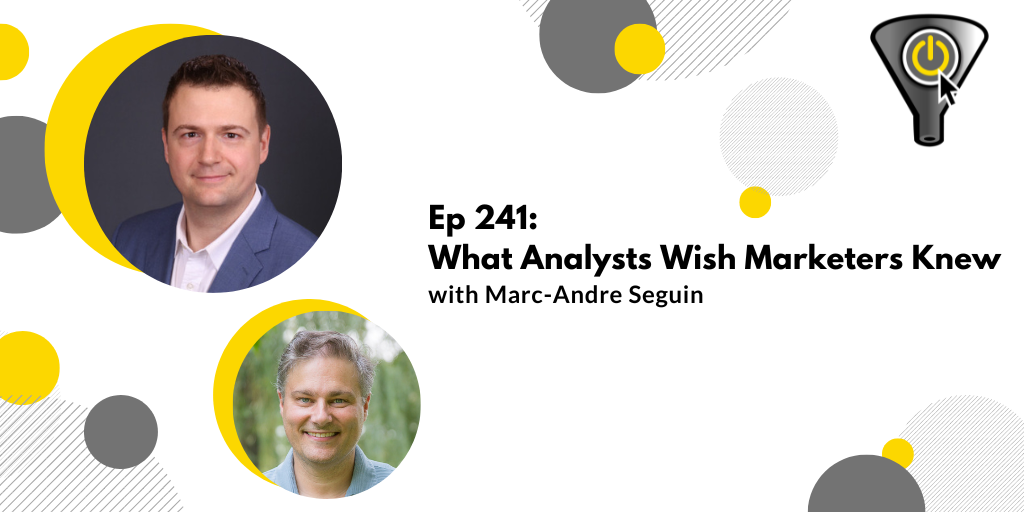
What Analysts wish marketers knew, with Marc-Andre Seguin
Some of us are lucky enough to work in a place with analysts who can help us make sense of our data. But there are added challenges in making this collaboration work.
Analysts may struggle with the questions marketers ask, finding them too vague for analyzing.
Marketers may get data back that they find irrrelevant; they may assume the analyst misunderstood their request. I’ll grant that we can speak the same language, but that isn’t enough. An Analyst cannot look at all the data, they cannot do analysis that will answer all your questions. The outcome you get will match the old movie Cool Hand Luke, which put it this way, WHAT WE’VE GOT HERE IS A FAILURE TO COMMUNICATE.
The solution is for both sides to learn just enough of how the other’s world to have meaningful dialogues all the way from problem scoping to decision-making.
My guest today has been on the analyst’s side of that table. He knows what practices determine whether this partnership works or fails. Graduating with a B.Sc. in Statistics, he has served as a Business Intelligence (BI) professional at various Government agencies and school boards. He is at home using tools like GA4, IBM Cognos to Microsoft PowerBI and writing in languages like SQL, DAX and Python.
He’s also previously been a professional jazz musician, which led 17 years ago to him founding JazzGuitarLessons.net, a site selling online guitar courses to budding musicians. running the ecommerce and email aspects of that site using his knowledge of analytics proves how well he knows what information we need on the marketing side of the business.
Let’s go to Gatineau Quebec to learn what analysts need from marketers to do their best work, with Marc-Andre Seguin.
Chapter Timestamps
00:00 Intro
03:07 Meet Marc-Andre
05:58 Bias And Ground Rules
07:10 Data Quality And Signal
08:51 Cost Of Analytics Stack
11:35 What Makes Analysts Great
13:35 SME Habits That Help
17:29 Communication And Personalities
19:32 Chatbot Announcement
19:59 Stats And Tools For Marketers
23:53 Using LLMs With Guardrails
26:20 Wrap Up And Where To Find
People/Products/Concepts Mentioned in Show
Marc-Andre’s .jazz guitar site
The Personal Branding Book, with Daria Dmitrieva
Episode 240
When I ask how someone forms their perception of a brand, what comes to mind? It might be they hear about it by word of mouth, or on an email thread or private message. In a nutshell, what’s said about our company when we’re not in the room, when we’re not in control of the message.
Now try the same experiment with our personal brand. Is our immediate thought how to look as good as possible? Is it how to curate the results that pop up when they search our name? Truth is, our personal brand has already been formed, we just weren’t in on those conversations.
Being active on our social media accounts can help, but we can also send the wrong brand message, shooting ourselves in the foot. When I first got onto Facebook and X, I feared that posting too much content would make me look distracted. When I did post, I felt a certain portion of them should be about my company or at least something generic. If I did have an opinion, it had to be watered down.My thinking was I should talk how my employer wanted me to talk. Turns out that is the complete opposite of how I should have been branding myself.
It wasn’t until I hung out my own shingle, that I realized being a generic-sounding consultant made me a commodity. That meant my rates were set by the market – I had to be a price-taker. But employees who act generically are also treated as commodities who must take whatever salary is offered. So regardless of where you sit, you’re better off with a good personal brand.
Am I saying employees should kiss ass on social, posting about how much they love their work? No. They can post thoughtful criticisms about the industry, they can post solutions to problems they and their peers face. Content like this boosts a person’s brand without offending employers. They know you won’t always be working for them; they’ll bask in your halo while they can get it.
But before you put out content you have to get introspective on what your brand stands for. It’s hard for us to stare at a sheet of paper and figure this out, we get better results using a framework. And this is where our guest can help.
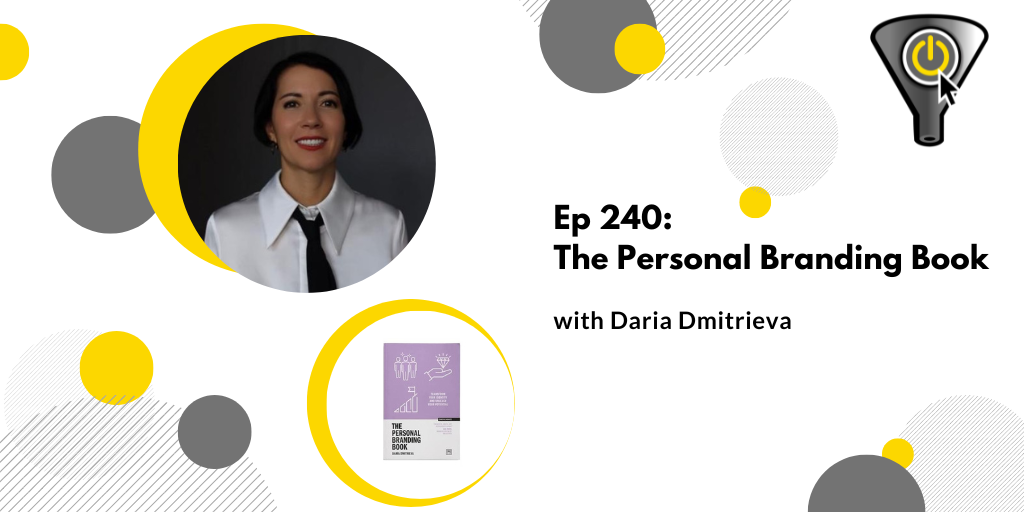
Since getting her MBA from Moscow International Higher Business School, she has managed some of Europe’s largest brands, from Stollwerck, to Nestlé and Shell. She is also a visual artist, marketing consultant and coach. Her 2026 book deals with this very issue.
Let’s go now to the French seaside resort town of Cannes to speak with the author of “The Personal Branding Book”, Daria Dmitrieva.
Chapter Timestamps
00:00 Intro
02:27 Meet Daria Dmitrieva
03:12 Brand As A Compass
05:55 Premium Brand Parallels
08:56 Authenticity Over Packaging
13:33 Fear And The Shadow Gift
19:04 Become A Magnet
22:26 CEO Dreamer Critic Roles
26:33 Body Cues And Intuition
28:39 Celebrate Progress
32:02 Daria Origin Story
35:35 Where To Find The Book
People, products mentioned in this episode
Balancing Data in B2B Partnerships, with Brendan Ziolo
Episode 239
“Black Swan” author Nassim Nicholas Taleb says “understanding how to act under conditions of incomplete information is the highest and most urgent human pursuit”
He might have been referring to B2B marketing. Think of it. Internal teams have internal data that give insight into customer accounts and lifetime value. Their agencies are close to different data: media auction signals, campaign trends. But both of them are data-poor, disadvantaged by limited access to each others’ systems.
As long as we tolerate the status quo, both sides will keep making false assumptions and poor decisions that harm their relationship.
The same problem’s existed in occupations and athletic pursuits, where having one person do it all brings the risk of making a wrong move. The solution is a two-person-team, where each compensates for the others’ blindspot.
One of the earliest examples comes from a young French acrobat in the mid 1800s who experimented with an aerial act he and a teammate performed over a pool. He was Jules Leotard, and yes, his name’s become synonymous with the gymnast outfit he wore.
His most dangerous maneuver started up high on his trapeze, with a teammate who’d dangle by their legs as they swung from their trapeze. When they were at the apex of their swings, he’d vault off into the air, to be grabbed by his teammates’ arms. Talk about trust!
There are many modern equivalents where people work in pairs: we have baseball pitchers and catchers exchange signals, synchronized swimming pairs vault each other out of the water. Airplanes are flown by captains and co-pilots, police and military cover for each other in tactical operations, or train Locomotives which are jointly operated by an Engineer and a Conductor.
Our guest strives for 360 degree views of data shared between his agency and clients.
He has done B2B marketing for startups and brands like Nokia and Alcatel-Lucent.
In 2023 he founded Zinc Marketing, working for B2B technology companies. Beyond this, he has been featured in ABC, BusinessWeek, as well as tech and healthcare publications.
He is also co-host of the B2B Marketing Pint podcast, and his love of camera gear helped us still record when some of my equipment broke.
Head with me to a local pub to hear about trapeze performances done by agencies and clients, from Brendan Ziolo
Chapter Timestamps
00:00 Intro
02:08 Meet Brendan Ziolo
03:22 Agency vs In House Data
06:00 Beyond MQLs to Revenue
11:25 Funnel Alignment Fixes
12:42 Radical Transparency
16:48 Qualifying Clients Fast
19:22 Directional Targets and Scaling
24:30 AI Needs Humans
29:56 Quality Over Quantity
30:52 Email Autopsy and Wrap
People/Products/Concepts Mentioned in Show
Brandon’s agency Zinc Marketing
Email Autopsy series on YouTube
The B2B Marketing Pint podcast
B2B Marketing Pint (@b2bmarketingpint)
Brendan on Instagram (@b2bmarketingdude)
Content, Simplified with Lee Densmer
Episode 238
Talk of Content marketing started appearing online around 2007. One of the few people who started talking about it was former Funnel Reboot guest Joe Pulizzi. It wasn’t until 2014 I became aware of marketers who were staking their career on the profession of creating content. I found the idea of giving-away-expertise a bit unsettling. Maybe it was because for a dozen years prior to that, I’d mainly communicated with audiences through paid ads. Gradually, Content marketing won out – we simply expect content on social media brings marketing results.
Only one problem, our guest says most of us aren’t doing content marketing right. One of her main critiques is that we’re making too much of it..
I’ll use myself as an example. Let’s look across the various accounts I’ve had on twitter/x; that have a combined 40,927 posts. Of those, analytics says only about 200, or 0.5% of them were home runs. If I’d known how our guest turns less into more; my marketing results could have been very different. I would also have been less stressed and would have slept better.
Our guest is founder of Globia Content Marketing agency. After earning two Bachelor’s degrees, from the University of Puget Sound and Boise State University, and completing her Master’s at the University of Colorado Boulder, our guest spent two decades as an in-house B2B marketer. Wanting to improve how content marketing’s done, she started posting on LinkedIn and built a sizable following and hung out her shingle in 2023. In 2025, she published her book Content Simplified.
Let’s go to Boise Idaho to speak with Lee Densmer
Chapter/Timestamps
00:00 Intro
01:34 Meet Lee Densmer
02:46 Why Content Fails
04:08 Quantity Trap
05:47 Three by Five Framework
07:27 Set Three Goals
09:23 Burnout Social Example
10:48 Pick Three Buyers
15:14 Choose Three Themes
17:09 Mission Statement Focus
19:29 Stay In Your Lane
21:08 Avoid Endless Debates
22:28 AI Limits And Guardrails
25:54 SME Interview System
28:30 Chatbot Announcement
28:59 CEO Approval Bottleneck
30:59 Channels Promotion Repurpose
33:48 Metrics That Matter
36:29 Proving ROI And Budgets
37:21 Book details & Wrap Up
People, products, concepts mentioned in the show:
Lee’s book: https://leedensmer.com/book
Lee on LinkedIn: https://www.linkedin.com/in/leedensmer/
Goodreads page for book: https://www.goodreads.com/book/show/243764645-content-simplified
Lee’s email lee@globiacontent.com
If you want to catch Ashley Faus’ episode, click here.